
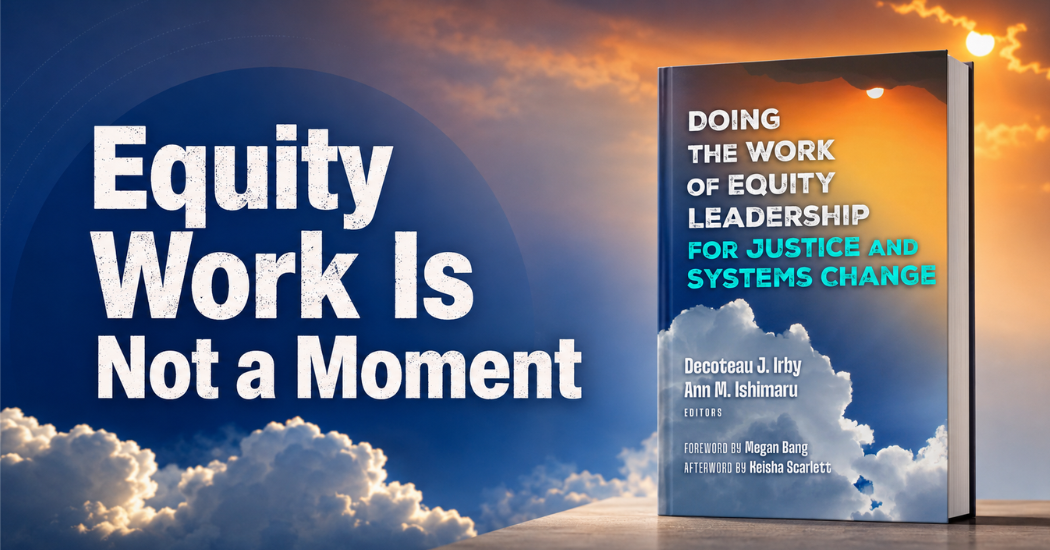
When Ann M. Ishimaru and Decoteau J. Irby began working on Doing the Work of Equity Leadership for Justice and Systems Change, they were not trying to write a conventional academic book or a neat leadership manual. They were trying to capture something harder to pin down: what it actually takes to keep equity work alive inside schools and districts over time, especially when the climate around that work keeps changing.
The book arrives at a moment when equity work in education is being challenged, restricted, and in some places dismantled. That makes the project feel less like a retrospective and more like a record of what educators, families, and communities have been building, often under pressure and often without much public recognition.
“This is not a typical academic research book, but it also doesn’t tell people step by step how to lead in the current moment. Instead, the book reflects lessons from both practicing educational leaders and scholars about the work of transforming systems towards equity across nearly a decade of efforts in different contexts in the U.S. The “morning” work of new policies, roles, and audits starting around 2014 gave way to “midday” work after 2020, resulting in greater resources, urgency, and institutional commitments. The pushback and retrenchment of evening work came all too quickly, which has accelerated into the current “night,” a time of explicit and federally-backed attacks on equity work, public education, democratic governances, and on racially minoritized and immigrant students, families and communities.”
That sense of time is central to the book. Ishimaru and Irby are not writing about equity as a single initiative, a school board debate, or a training session. They are interested in the longer arc: the years of policy changes, community pressure, institutional commitments, backlash, and rebuilding that shape what happens inside schools.
For parents, that arc can feel far away from the daily realities of getting a child through the school day. But Ishimaru and Irby argue that families are part of the work, especially now. They point to the importance of adults building networks strong enough to protect children and sustain educators.

“In the book, leaders “doing the work” amid vitriolic pushback shared crucial lessons about building coalitions and networks to continue the work and sustain themselves holistically. So supporting kids in this climate means making sure that especially those impacted by immigration enforcement activity feel both safe and knowledgeable, and they know that the adults around them are deeply committed to their wellbeing and are working together to support them. As devastating as it has been, educators and parents across the country – especially in Chicago, LA, and Minneapolis – have been coming together with their neighbors, community members, and local businesses to protect their children, schools and communities.”
It is a practical answer, but also a moral one. Children notice when the adults around them are organized, calm, and clear about their safety. They notice when schools and communities do more than issue statements. They notice when people show up.

The book has also changed in meaning for its authors. What began as an effort to document equity leadership has become, in the current climate, an argument against forgetting. Ishimaru and Irby now see the book as part of a larger struggle over what gets remembered, what gets erased, and whose work counts as legitimate.
“When we were first writing and editing the book, we did not anticipate the conditions and climate that would exist when the book came out. We’re now in a time when the powers-that-be are actively seeking to erase equity roles, offices, and years of work from both K-12 and higher education. Thus, the book has taken on new significance as a refusal to erase the work to cultivate schools that tend to the dignity, learning, success, and wellbeing of all the many children they serve. In writing and sharing the book, we have learned how important it is for educators to reflect on and record their practice and strategies in pursuing systemic change over a longer arc of change-making.”
That may be the book’s most urgent contribution. It does not pretend that equity leadership is easy, linear, or protected from politics. It also does not treat the current backlash as the end of the story.
Instead, Doing the Work asks readers to look closely at the people who have been building more just schools, often in difficult conditions, and to take seriously the knowledge they have earned. For Ishimaru and Irby, that knowledge is worth preserving. It is also worth using.


