
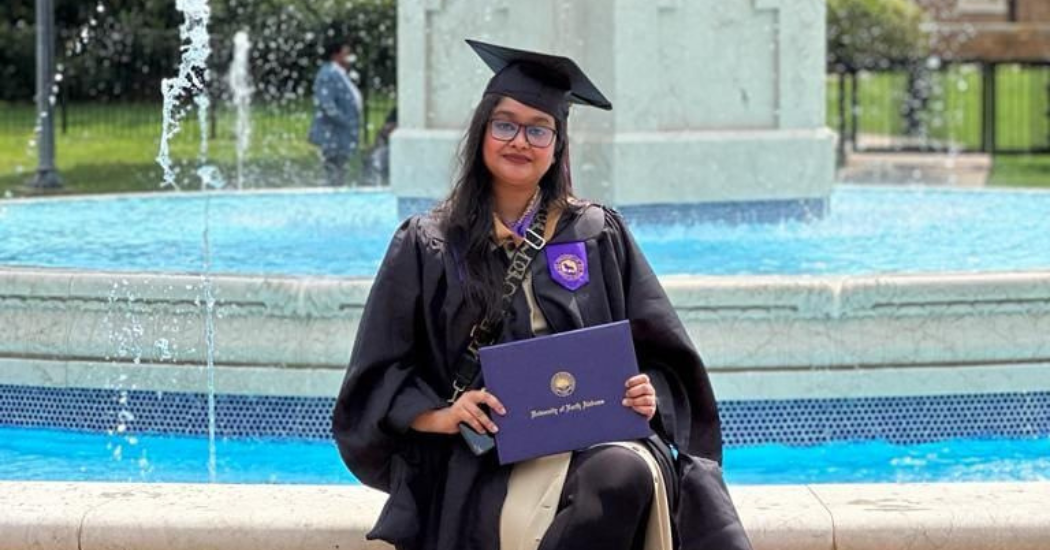
While many doctoral students focus on a single lane of research, Ananna Mosaddeque, a Bangladeshi international student pursuing a PhD in Business Administration with a concentration in Accounting at the University of Memphis, is building an interdisciplinary fast lane.
Her Google Scholar profile reveals a scholar who refuses to be boxed in by traditional ledgers. By integrating Information Systems with accounting principles, Mosaddeque is tackling some of the most pressing challenges in the American healthcare industry and beyond.
Accounting Meets Algorithm
Traditional accounting focuses on tracking past transactions. But Mosaddeque’s work focuses on the future-specifically, how information systems can automate and secure financial and operational data.
Her most cited work, “The Role of AI and Machine Learning in Fortifying Cybersecurity Systems in the US Healthcare Industry” (2022), highlights her core thesis: You cannot have accurate accounting without secure information systems. With 17 citations, the paper argues that as hospitals digitize patient records and billing, accounting systems are only as reliable as the cybersecurity protecting them.
Strategic Resource Optimization
Mosaddeque doesn’t just look at security; she looks at efficiency. In her collaborative paper, “The dynamics of AI and automation in financial forecasting, human resources planning, and resources optimization for designing an effective national healthcare policy,” she explores how automated information systems can solve the U.S. healthcare system’s notorious waste problem.

By utilizing information systems to forecast financial needs and optimize human resources, she argues that policymakers can design national health policies that are not just clinically sound, but financially sustainable.

Venturing into Mental Health and Smart Cities
Her recent work from 2025 shows a scholar expanding her problem-solving toolkit. In “Exploring the impact of generative AI and virtual reality on mental health,” she examines how emerging information technologies can serve as therapeutic tools-raising new accounting questions about liability, cost-benefit analysis, and insurance reimbursement for virtual care.
Similarly, her paper on “Wireless Energy Transmission in Smart Cities” looks at how accountants must redesign incentive structures when cities adopt new energy tech. Here, information systems become the backbone for tracking, verifying, and incentivizing wireless power transfers.
A Global Perspective
Coming from Bangladesh, Mosaddeque brings a unique lens to the University of Memphis. While her research focuses heavily on the U.S. healthcare and smart city infrastructure, her background suggests an acute awareness of how information systems can leapfrog traditional developmental hurdles in emerging economies.
Solving the “Translation” Problem
According to her research trajectory, the biggest problem Mosaddeque is solving is the “translation gap”-the failure of different departments (accounting, IT, HR, clinical staff) to speak the same data language.
By utilizing Information Systems, she is building bridges that allow financial data to inform cybersecurity, and for clinical needs to be accurately reflected in fiscal forecasts. For a PhD candidate, that is a rare piece of systems thinking.
As she continues her studies at Memphis, Ananna Mosaddeque is proving that the future of accounting is not just about numbers on a page-it is about the integrity of the data flowing through the machine.


